Nearly six years ago, I had a cesarean section. It wasn’t planned: I went through the pregnancy and into labor expecting my daughter would be born the so-called normal way. Still, over 24 hours went by, and although my cervix had dilated fully, it was clear my vagina wasn’t big enough to fit her through. So I was wheeled into an operating room, where my belly was exposed (actually, I was more or less naked for a considerable portion of the surgery), scrubbed with antiseptic, cut open with a surgeon’s knife, and -once the baby was removed – sewn up, stapled, and bandaged.
The result was a red line running horizontally along my abdomen about three inches under my navel. On my second day home from the hospital, four days after my daughter’s birth, my incision opened up slightly, prompting me to put ice on it (which did alleviate the soreness). Over the coming months, the soreness and itchiness eventually went away – even though even now several years later, I can sometimes ‘feel’ on my belly where I was sectioned and my daughter taken from my womb. My scar similarly faded, to the point where it now seems barely visible.
During those months I thought about the scar and, more importantly, the cesarean section itself. In my early twenties, I was very much into the natural childbirth ideal. A cesarean was at best a necessary evil for me. As one woman who had planned a home birth but had to have a scheduled cesarean section because her baby was breech said, in her mind home birth was good, hospital birth bad, and surgical birth unthinkable – until she was forced to undergo one.
By the time I hit my thirties, though, I was more comfortable with the idea of possibly needing a surgical birth myself. A couple of people ‘in the know’ had commented on my narrow pelvis, and I knew that the older I got, the higher my risks of being sectioned were if I got pregnant. So in the end, I wasn’t particularly surprised when the doctors told me that the only way my baby could come out of me was directly through my belly.
I also thought about the scar itself. I remember reading that after having a cesarean with her first child, actress Rita Hayworth had her wardrobe altered in such a way that the scar on her stomach wouldn’t show when she appeared in the movie Gilda. Feminist leader Gloria Steinem later spoke of a woman who never wore two-piece bathing suits because she didn’t want anyone to see her cesarean scar (Steinem, by the way, did not think the other woman should have been ashamed of her incision).
Eventually, I came to feel that I did not need to hide my scar on occasions where others might see it, like on the beach. Plus, I liked the fact that I could show my daughter exactly how and from where she was born. And I could advertise to everyone the fact that I had given life – through my belly, albeit with the help of the doctors and nurses at the hospital.
I then took a somewhat radical step: having my scar photographed. So after deliberating for some time, I called a local photographer and made an appointment to have my belly immortalized on camera. Ironically, when I went to the photographer’s studio, I noticed that a number of women had had ‘belly pictures’ taken of themselves when they were -often very heavily – pregnant. I too was getting a ‘belly picture,’ after the fact, so to speak.
Having my abdomen photographed was an experience in itself. As on the operating table, I was naked in the studio, my belly bare so everyone could see exactly from where my daughter had emerged. The photographer and his assistant zeroed in on me to find the best way of ‘capturing’ my scar. Finally, after switching the lighting and making me change positions a couple of times, they were able to get a good view of my cesarean ‘slice,’ my cut belly.
The photographer ended up taking a number of pictures of me, and my scar and abdomen, but I chose to pay for and bring home what I considered the best one (though they were all good). Speaking with me afterwards, he said that he had taken many photographs of women’s sectioned bellies but that I was the only one who was openly ‘proud’ of my scar.
And I am, of my scar and of my belly. Sometimes I wonder what people might think of me when if they see my scar at a beach or pool, for instance, or if the photographer decides to feature it in one of his work displays. Will they see me as one of those ‘too posh to push’ women (example: Victoria Adams)?
I will let you decide. Here is a picture of my cut belly.
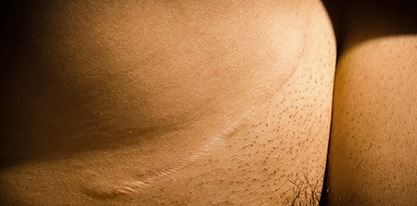
Photo shared with permission of Keith Penner.
I have a follow-up essay here:
Ten years later…
Just over a decade ago, I went to a photographer to have a picture taken of my caesarean scar, which I’d acquired several years earlier when I gave birth to my daughter. He took the picture, which I later used in a story for “Shape of a mother” titled “My cut belly.” Two years after that, I went back to the photographer to have some more pictures taken. How had my body changed in the years since having my daughter (and only child)?
Since then, a number of things have happened. First, I broke up with my daughter’s father, to whom I’d never been married. Nothing particularly dramatic: we just sort of drifted apart. Some years following that, I met another man and tried, unsuccessfully, to conceive again. By that time I had entered perimenopause, and eventually, the month before my 53rd birthday, I had my final menstrual period, thereby losing any hope of conception.
During this time, what changed about my body? First, my c-section scar is still there – although it’s faded somewhat – and I can “feel” it at times. The photographer who took the picture of my sliced abdomen said my scar was “cute.” I think of how former Spice Girl Geri Halliwell, “Ginger Spice,” who also gave birth surgically, said she liked her incision because it resembled a smile. I say that my belly is smiling too: first, because I’m happy to have my daughter, and, second, because without the operation, I would not have survived childbirth; my vagina is simply too narrow to let me deliver naturally. I remember in a book called Boobs, a Canadian woman described the scar from open heart surgery she had as a child as a “faded old friend that keeps me mindful of gratitude.” I can say the same about my caesarean scar.
Speaking of “boobs,” another memento of my reproductive career are my breasts. Somewhat to my disappointment, they never got bigger even after nine months of pregnancy and two and a half years of nursing a baby – although they did feel very full at first when they were working overtime as they adjusted to my daughter’s feeding schedule. But my mother, who was not much “bigger” than I am, told me of an advantage of small breasts: when you get older, they don’t sag as much. What immediately came to my mind then was performance artist Annie Sprinkle’s “Anatomy of a pin up” picture. In it, she declares about her rather large mammary glands, “Breasts are real but sag. Bra lifts breasts.” I laughed but had to admit to a certain satisfaction that perhaps some of the “well-endowed” girls I had envied in my youth were now dealing with sagging breasts. However, when I met a woman who had had huge breasts and had them surgically reduced, I realized that being well-endowed isn’t necessarily a walk in the park. This woman spoke of endless back pain and difficulty finding a comfortable position to sleep in. I worry about my daughter, who at 17 has much bigger breasts than I do (hers are a bit like the tortoise in the story of the tortoise and the hare: she started “developing” at an older age than I did, but while my breasts basically stopped growing when I was about 14, hers marched on).
What has changed is something that wasn’t captured on camera: my period. A few months after I turned 51, I entered perimenopause, the time leading up to actual menopause or cessation of menstruation. My period started coming every few months rather than once a month, which it had pretty much like clockwork even in my late forties and at 50. Ironically, this occurred just as my daughter began menstruating at the age of 12 and just as I was trying to conceive another time. I wasn’t too shocked at not being able to get pregnant. Against me were not only my age but also the fact the man I was seeing may well have been infertile. I think of Corinne Paraplaix, a Frenchwoman who made headlines in the 1980s when she sought to be inseminated with her late husband’s sperm so she could bear his child. Her attempt failed, but she said, “This child will always live in my heart.” Paraplaix ultimately remarried and had a baby; I wonder whether she still thinks of the child she could not conceive with her first husband. So for me, the baby I tried in vain to conceive will “live in my heart.”
Not that “the change” was particularly difficult for me. Still, the definitive end of my reproductive life had a certain finality to it. Now I’m content as a mother of one. My body, and the changes it has undergone over the years, are a reflection of my life and its many twists and turns.